Listen to this blog
1. The Hook of Hidden Dependency: The Legal Key
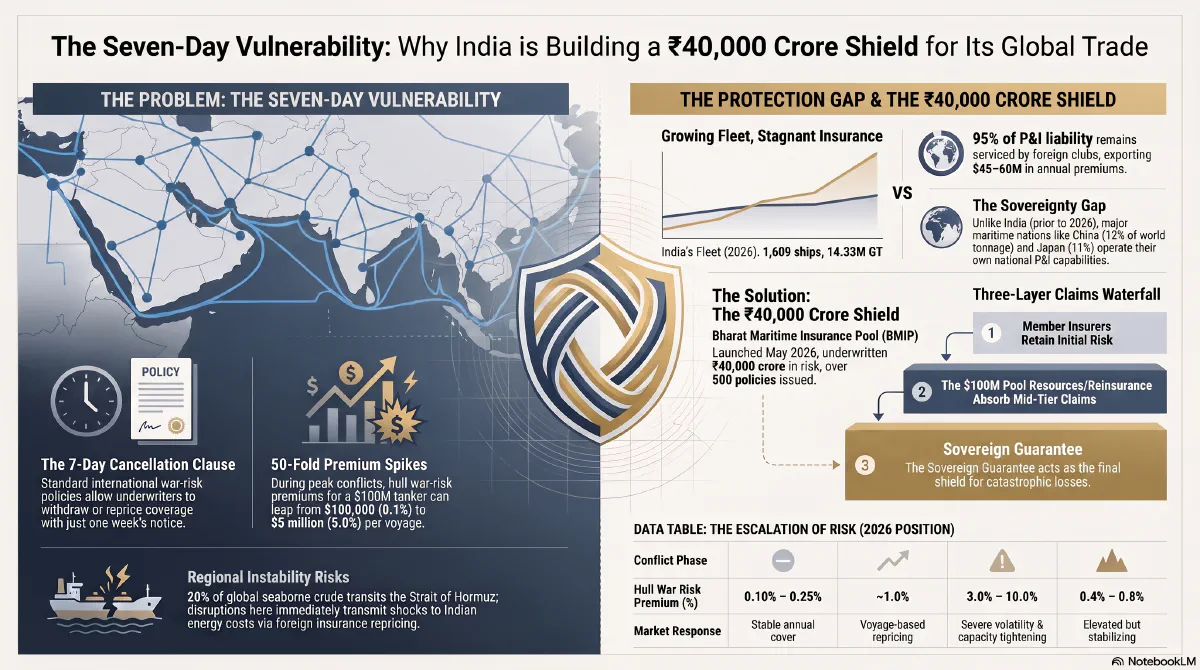
India’s maritime presence is undergoing a quiet but massive expansion. Since 2015, the Indian-flagged fleet has grown by roughly 36% in tonnage, reaching 1,609 ships and 14.33 million gross tonnage (GT) as of mid-2026. Yet, beneath this physical growth lies a critical paradox: while Indian ships carry our goods, their “permission to sail” is effectively held offshore.
This “permission” is not merely bureaucratic; it is a statutory mandate. Under the Merchant Shipping Act, 2025, P&I (Protection & Indemnity) insurance is the mandatory legal key for any vessel calling at Indian ports. Without a “blue card” from an accepted provider, a ship cannot secure the state-issued certificates required by international treaties like the Civil Liability Convention (CLC 1992), the Bunkers Convention 2001, and the Nairobi Wreck Removal Convention. Currently, over 95% of this mandatory cover is provided by foreign clubs, leaving India’s trade continuity subject to the risk appetite and geopolitical priorities of international markets.
2. The Multi-Million Dollar “Knowledge Export”
The financial cost of this dependency is significant, but the strategic cost is higher. Indian ship operators send an estimated USD 45–60 million in annual P&I premiums to foreign clubs. However, the true loss is the export of the infrastructure that supports those dollars.
When premiums flow abroad, so do the claims data, the loss-prevention know-how, and the specialized underwriting talent that a domestic market needs to mature. By relying on offshore providers, India is effectively forfeiting the intellectual capital required to manage its own maritime risks.
“A growing fleet without a growing domestic insurance base is, in effect, subsidising the development of foreign markets.”
3. The “Seven-Day Notice” Trap
Perhaps the most alarming vulnerability in the current system is the “standard seven-day notice of cancellation” found in international war-risk policies. This clause allows foreign underwriters to withdraw or reprice coverage at just one week’s notice if a region’s stability deteriorates.
For a nation like India, which imports the vast majority of its crude oil through the Strait of Hormuz, this is a strategic nightmare. Recent conflicts have demonstrated the fragility of this lifeline: as of March 1, 2026, traffic in the Strait declined by a staggering 86% following heightened tensions. If foreign insurers decide a route is too risky or if sanctions force them to step away, Indian tankers could find their insurance certificates lapsing almost overnight, effectively freezing the nation’s energy security.
4. The 50x Price Shock
Geopolitical conflict transforms shipping economics with brutal speed, creating what analysts call a “hard market.” Data from the “Hormuz and the Energy Lifeline” analysis shows that before conflict, hull war-risk premiums sat at a stable baseline of 0.10–0.25%. During peak conflict periods, severe volatility and capacity tightening have pushed these rates to between 3.0% and 10.0%.
To put this in perspective: on a USD 100 million tanker, a pre-conflict rate of 0.1% costs roughly USD 100,000 for a single transit. At a peak rate of 5%, that same voyage costs USD 5 million. This represents a fifty-fold increase in insurance costs for the exact same ship making the exact same passage. For an energy-dependent economy, these corrosive costs are eventually felt in the landed price of fuel and goods.
5. The ₹12,980 Crore Sovereign Shield
To break this cycle of dependency, the Indian government launched the Bharat Maritime Insurance Pool (BMIP) on May 12, 2026. Designed as a “sovereign shield,” the pool provides a domestic mechanism for underwriting complex risks that international markets might abandon—a move with direct precedent in Russia’s national reinsurance response to Western sanctions.
The BMIP utilizes a “Waterfall” claims structure to ensure stability:
- Layer 1: Claims up to USD 100 million are met using the pool’s own accumulated reserves, member contributions, and reinsurance.
- Layer 2: For catastrophic losses exceeding the pool’s resources, a ₹12,980 crore (USD 1.4 billion) sovereign guarantee acts as a backstop of last resort.
Crucially, this financial shield is linked to physical maritime safety through the parallel Salvage Hub initiative. Casualty events in 2025 off the Indian coast exposed how ad hoc, owner-driven responses lead to dangerous delays. By integrating with the Salvage Hub and onboarding specialized Special Casualty Representatives (SCR), the BMIP ensures that India has the operational control to manage emergencies rather than merely paying for them.
The pool has seen immediate real-world uptake, issuing policies to entities like Hoger Offshore, Balrampur Chini Mills, and Vedanta Sterlite Copper for specialized cable-wire imports.
BMIP Key Metrics Summary
| Metric | Value / Details |
|---|---|
| Launch Date | May 12, 2026 |
| Sovereign Guarantee Backstop | ₹12,980 Crore (USD ~1.4 Billion) |
| Risk Underwritten (to date) | ₹40,000+ Crore across 500+ policies |
| Mandatory Fleet Mandate | Merchant Shipping Act, 2025 |
| Primary Reinsurance Anchor | General Insurance Corporation of India (GIC Re) |
6. The “National Club” Evolution: The China and Korea Precedents
India’s strategy follows a proven roadmap established by other Asian maritime powers. The China P&I Club (CPI) and Korea P&I Club (KP&I) provide the blueprint for India’s evolution from a “fixed-premium” model to a “mutual” model.
At inception, the BMIP uses a fixed-premium model, where insurers charge a set fee and carry risk on their own capital to provide predictability and speed. As the pool matures and gains scale, the goal is to transition to a mutual model, where shipowners become the insurers themselves, sharing both risks and rewards to deliver greater capacity at lower long-run costs. The common thread in the success of these international clubs is the sequence: legal recognition and state backing must be established before scale and international acceptance can follow.
7. Conclusion: Toward Financial Sovereignty
The launch of the BMIP is more than a technical adjustment to the insurance market; it is an exercise in financial sovereignty. Since its inception in May 2026, the pool has already underwritten more than ₹40,000 crore in risk across over 500 policies, covering a versatile range of risks including Hull & Machinery (H&M), Cargo, and P&I.
By providing a domestic alternative that is insulated from foreign sanctions and sudden market retreats, India is securing the financial nerve-center of its trade routes. It raises a final, fundamental question for any emerging global power: can a nation ever truly be secure if the “permission to trade” remains a document issued by a foreign entity? cument issued by a foreign entity?