Listen to this blog
1. The Ancient Metal Powering the Modern Mind
There is a profound paradox at the heart of the silicon revolution. Artificial Intelligence, the pinnacle of human cognitive engineering, is currently hitting a physical wall built from a material humanity first mastered in 8000 BC. Copper, our oldest metal, has transitioned from ancient coins to the “connective artery” of modern civilization, and it is now the primary bottleneck for the world’s most advanced neural networks.
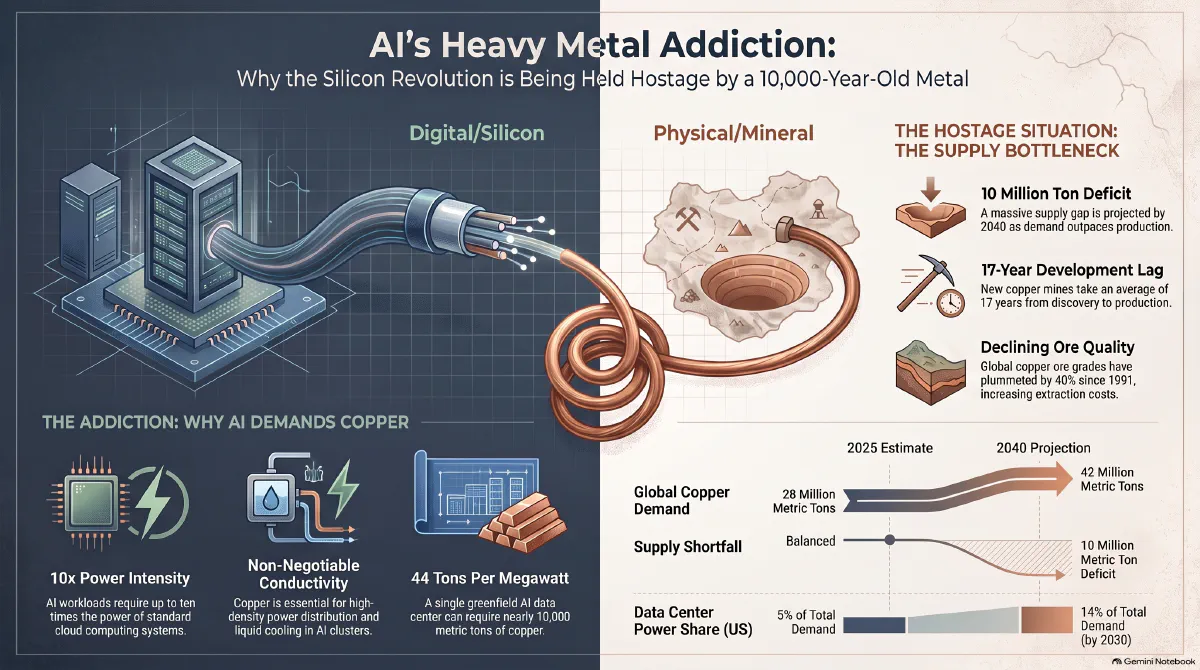
As of September 8, 2026, we have entered a “frighteningly real” supply squeeze. While the digital world operates in nanoseconds, the physical infrastructure supporting it is tethered to a sluggish geological reality. Current projections from S&P Global suggest an unprecedented surge: global copper demand is expected to jump 50% by 2040, climbing from 28 million metric tons to 42 million metric tons. The AI race is no longer just about who has the best algorithms; it is about who can secure the heavy metal required to run them.
2. AI’s Heavy Metal Diet: More Than Just Silicon
Why does a digital mind require so much physical metal? The answer lies in the sheer intensity of AI workloads, which require up to 10 times the power of standard cloud computing. This massive energy appetite necessitates a copper-heavy overhaul of data center architecture:
- High-Purity Distribution: To manage massive currents, data centers are ditching heavy cable bundles for copper busbars—high-purity strips that safely distribute electricity across switchgear and server racks.
- Safety and Grounding: AI facilities require grounding rods, electrodes, and ground rings to protect hardware from surges. Copper’s stable electrical properties and corrosion resistance make it the only viable choice.
- The Cooling Shift: AI chips generate heat at a scale air cannot manage. Most modern facilities are pivoting to direct-to-chip liquid cooling. Because water conducts heat 30 times better than air, these systems rely on copper cooling plates mounted directly onto the processors.
The hunger for copper is further intensified by a new vector of demand: humanoid robots. Whether the fleet reaches tens of millions or a billion, these machines will be “heavily wired” with copper to facilitate the complex motor functions and sensory processing required for human-like movement. The fundamental conflict remains the tempo of development; a tech giant can announce a multi-billion dollar AI campus in months, but the physical power grids and mining operations required to sustain it take decades to expand.
“Advanced cooling systems account for nearly 40% of data center energy consumption. Since water conducts heat around 30 times better than air, most data centers use liquid cooling technologies… which rely on copper cooling plates.”
3. The “Manufactured” Shortage: Why America is Hoarding
While the long-term deficit is structural, the market is currently gripped by a “geographical distortion” driven by speculative arbitrage. On September 8, 2026, benchmark copper on the London Metal Exchange (LME) hit a record $14,533 per tonne.
The driver is the “tariff trade.” Following a 2025 proclamation that designated copper as a critical mineral, the US initially spared refined cathodes from import levies. However, with a recommended 15% tariff looming for January 2027—rising to 30% in 2028—traders are aggressively pulling copper into US warehouses to avoid the future bill. This has created a startling contradiction: copper is piling up in record quantities in US COMEX warehouses while draining from the LME.
Key Market Metrics: The Copper Hoarding Phase
| Metric | Value / Details |
|---|---|
| LME Benchmark Record | $14,533 per tonne (September 2026) |
| US Refined Imports | 220,000 tonnes (July 2026 peak) |
| COMEX Inventory Inflow Streak | 46 consecutive trading days |
| Pending US Import Tariffs | 15% (Jan 2027) → 30% (2028) |
“The world may still possess enough refined copper for current consumption. It no longer possesses enough copper in the places buyers need it.”
4. The 17-Year Waiting Room: The Geological Supply Lag
The market cannot simply “turn on the tap.” Mining moves at a glacial pace compared to software development, with the timeline from discovery to production now averaging 17 to 18 years.
This lag is exacerbated by the decline of “low-hanging fruit.” Global copper ore grades have declined by 40% since 1991, forcing us to dig deeper and process more rock for the same yield. This is turning copper into “the new oil”—an essential fuel for the energy transition that is increasingly expensive to recover.
The desperation is most visible in the smelting sector. Treatment and Refining Charges (TC/RCs)—the fees smelters charge to process ore—hit an all-time low of zero (and in some cases, negative) in 2026. Smelters are now surrendering their income just to secure scarce raw materials. As the saying goes: “The furnace may be Indian. The ore feeding it frequently is not.”
5. The Recycling Paradox: The Limits of Re-use
Recycling is often cited as a panacea, but we are currently trapped at a 32% recycling rate for end-of-life copper. The barrier isn’t just lack of collection; it’s the evolution of tech itself.
Extreme miniaturization in AI hardware means copper is bonded in tiny fragments with complex, often hazardous materials. Extracting these “bits” is so convoluted and costly that the processing price often exceeds the value of the recovered metal. Without a massive leap in collection infrastructure and separation tech, the “circular economy” for copper remains a distant aspiration.
6. India’s Industrial Warning: A Case Study in Vulnerability
The strategic risk of the copper crunch is perfectly illustrated by India. Once a net exporter, India became a major importer after the 2018 closure of the Sterlite plant.
India’s demand is rising at nearly 10% annually, driven by the “Housing for All” initiative and a massive infrastructure push, including the electrification of 126,000 km of railway track. Projections suggest demand will hit 9.8 million tonnes by 2047, yet the nation depends on imports for 90% to 95% of its copper concentrates. In New Delhi, “copper security” has officially transitioned from a commodity price issue to a core pillar of national industrial policy.
India’s Copper Vulnerability Profile
| Metric | Value / Status |
|---|---|
| Annual Demand Growth Rate | ~10% per annum |
| Projected Demand (by 2047) | 9.8 million tonnes |
| Import Dependency (Concentrates) | 90% – 95% |
| Domestic Refining Disruption | Closure of Sterlite Copper (2018) |
| Core Demand Drivers | 126,000 km rail electrification & Housing for All |
7. Conclusion: The Supercycle or the Bottleneck?
The copper market is currently pricing two different futures. In the short term, the $14,533 peak may be a speculative “tariff bubble.” In the long term, however, the structural deficit is frighteningly real.
We are left with a fundamental question: Can the digital revolution survive a physical world that moves 17 years slower than a software update? As humanoid robots and AI data centers mushroom across the globe, the constraints of a 10,000-year-old metal have become the ultimate speed limit for human innovation.
“The digital revolution has finally met its physical speed limit: a 17-year wait for the metal that makes intelligence possible.”