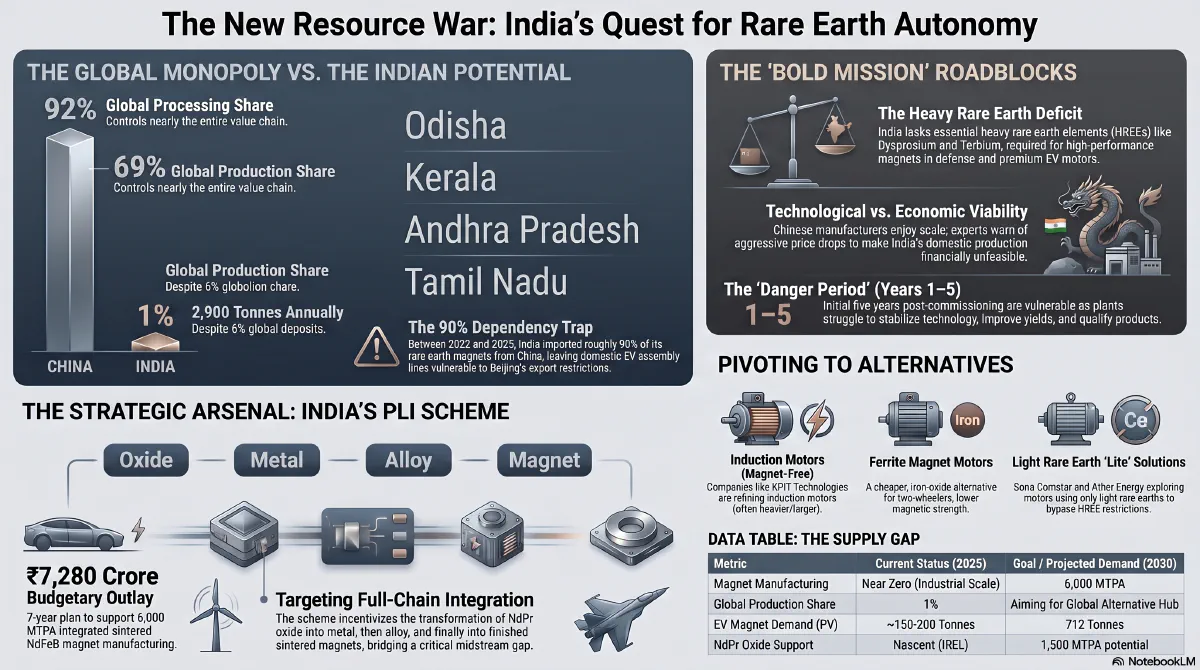
Rare earth elements are frequently referred to as the “vitamins of modern industry,” playing an indispensable role in everything from electric vehicles (EVs) and wind turbines to consumer electronics and high-tech defence systems. Despite possessing approximately 6% of the world’s rare earth deposits—amounting to an estimated 7.23 million tonnes of rare-earth oxides—India has historically accounted for just 1% of global production. Astonishingly, between 2022 and 2025, India imported between 84% and 90% of its rare earth permanent magnets directly from China.
This deep dependency is a severe strategic vulnerability. China currently dominates the global rare earth supply chain, commanding 69% of global rare earth production and an overwhelming 92% of the world’s processing capacity. The reality of this monopoly hit hard recently when Beijing tightened export controls on essential rare earth processing equipment, machinery, and materials. For India’s rapidly growing EV and tech sectors, these restrictions threatened to choke supply lines, potentially delaying manufacturing timelines and pushing up project costs significantly.
The ₹7,280-Crore PLI Push
Recognizing the critical need for supply chain resilience, the Indian government has launched a massive ₹7,280-crore Production-Linked Incentive (PLI) scheme. This ambitious seven-year initiative is designed to build an end-to-end domestic ecosystem, targeting a manufacturing capacity of 6,000 tonnes per year for sintered rare earth permanent magnets. The plan aims to bridge the gap between upstream extraction—currently monopolized by the state-run IREL (India) Ltd—and downstream, high-tech magnet fabrication. By inviting private sector participation, India hopes to convert its rich coastal sand deposits into a reliable domestic supply of neodymium-iron-boron (NdFeB) magnets.
Engineering Workarounds & Alternatives
However, the Indian automotive sector isn’t just waiting for the factories to be built; they are actively engineering workarounds to bypass the geopolitical bottleneck. Leading companies are exploring motor technologies that eliminate or reduce the need for heavy rare earth elements entirely. For instance, Ola Electric has taken the lead in introducing rare earth-free induction motors, while start-ups and established players like Sona Comstar and Ather Energy are testing alternatives such as ferrite magnet motors and light rare earth magnets. Others are strategically stockpiling existing supplies or exploring dual-sourcing partnerships to ensure their EV assembly lines keep moving.
“Breaking this monopoly will not happen overnight, but achieving self-reliance in rare earth magnets is essential for India to confidently drive the global green energy transition.”
The mission to counter China’s dominance is bold but fraught with challenges. Indian manufacturers face a steep technical learning curve, exorbitant costs for specialized processing equipment sourced from countries like Japan and Germany, and the looming threat of strategic price undercutting by established Chinese suppliers. Nevertheless, through a combination of government incentives, technological innovation, and international partnerships, India is finally laying the critical groundwork to secure its supply chain.