Listen to this blog
The India Energy Paradox
India currently grapples with a high-stakes energy paradox. As the nation targets a $5 trillion economy, the resulting infrastructure boom—most notably a data center capacity projected to hit 8 GW by 2030—is creating an insatiable demand for 24/7 baseload power. While India’s renewable expansion is world-leading, solar and wind cannot yet provide the “always-on” stability required by a digitized economy. Historically, this gap was filled by coal or a state-monopoly nuclear sector. However, we are witnessing a structural transition: the shift from government-controlled atomic energy toward a private-sector-led renaissance.
The catalyst is the Adani Group’s recent 10 GW nuclear target, a move that effectively signals the liberalization of India’s most protected energy frontier.
The 10 GW Pivot: Adani’s Strategic Entry
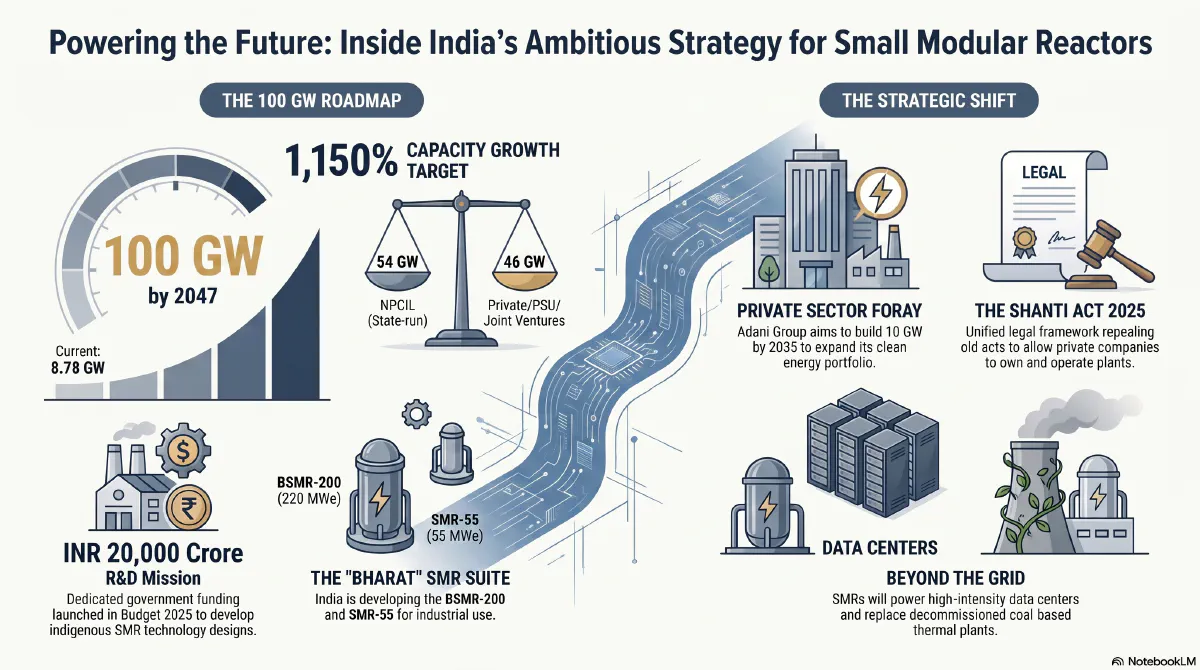
The Adani Group has formally announced a target of 10 GW of nuclear capacity by 2035, to be executed under a new business unit, Adani Atomic Energy. The group has already begun identifying land for these projects, specifically in Uttar Pradesh, positioning itself to become India’s third-largest operator after the state-run NPCIL and NTPC. This is not merely an energy play; it is a capital expenditure statement. In FY26 alone, the conglomerate invested over ₹ 1.5 lakh crore in infrastructure—representing 30% of India’s total new private-sector capital expenditure.
This entry marks a decisive break from the dominance of the Nuclear Power Corp of India (NPCIL). To sustain this momentum, the group is leveraging its recent market success; while Gautam Adani recently described the group’s successful ₹25,000 crore rights issue as a “referendum on our credibility,” that same market confidence is now being diverted into the complexities of the atomic fuel cycle.
“Our entry into nuclear energy through Adani Atomic Energy is another confident step towards securing India’s long-term energy future. With land identified and a 10 GW targeted capacity by 2035, we are positioning ourselves early to serve the growing national demand for clean, round-the-clock power,” stated Gautam Adani.
The Legislative Silent Hero: The SHANTI Act 2025
The regulatory “unlock” for this pivot is the Sustainable Harnessing and Advancement of Nuclear Energy for Transforming India (SHANTI) Act, 2025. By repealing the restrictive 1962 Atomic Energy Act, this legislation effectively ends the state monopoly, permitting private firms to build, own, and operate nuclear plants. Crucially, the Act resolves the “right of recourse” liability issue that had paralyzed the sector since 2010. By aligning with international standards and restricting liability to cases of deliberate damage or specific contractual breaches, the Act has cleared the path for both domestic conglomerates and foreign suppliers.
From an analyst’s perspective, this mirrors the 2022–2024 surge in India’s space industry. Further signaling a move toward global integration, the government is considering a revised Foreign Direct Investment (FDI) policy that could allow up to a 49% FDI cap in the nuclear sector, provided majority ownership remains with Indian entities.
SMRs: The “New Oil” for the Data Center Economy
Small Modular Reactors (SMRs)—defined by capacities up to 300 MWe—are the tactical core of this new strategy. Unlike conventional mega-reactors, SMRs are designed for factory assembly and serial production, offering a modular solution to hyper-local industrial demand.
External Affairs Minister S. Jaishankar famously synthesized the synergy: “If data is the new oil, then data centers are the new refineries that will need to be powered.”
But one must note the Technology Readiness Levels (TRLs) and associated risks. Both NITI Aayog and ORF reports caution that initial SMR projects currently inherit the high costs and complexity of conventional reactors. There is significant “cost uncertainty” in these early stages, and the “paradigm shift” in economics will only occur once the industry moves toward Nth-of-a-kind (NOAK) manufacturing. Nevertheless, SMRs offer a reduced exclusion zone of just 0.5 km (versus 1.5 km for traditional plants), making them ideal for placement near the industrial clusters and data centers that will drive India’s future.
Repurposing the Past: The Brownfield Advantage
A major pillar of the national strategy involves a “brownfield” approach: identifying ten decommissioned thermal power plants for conversion to nuclear baseload sites. This strategy is an efficiency masterstroke. By utilizing existing transmission networks, rail connectivity, and water availability, the industry can bypass the typical four-year land acquisition delays and the social displacement costs that often derail greenfield infrastructure. Converting retired coal assets allows for a rapid transition to clean baseload power while maintaining grid stability without the friction of new site scouting.
Indigenous Innovators: The BSR and “ApuRVA”
India is prioritizing an “Atmanirbhar” (self-reliant) atomic ecosystem, spearheaded by the Bhabha Atomic Research Centre (BARC). The domestic technology pipeline is technically dense and heavily funded:
- BSMR-200: A 220 MWe reactor targeted at industrial captive power, with an estimated development and construction cost of ₹5,960 crore. Lead units are proposed for the Tarapur Atomic Power Station in Maharashtra.
- SMR-55: A 55 MWe unit designed for remote, off-grid applications. The government has allocated ₹7,000 crore for the construction of two such units.
- HTGCR: A high-temperature gas-cooled reactor (up to 5 MWth) planned for BARC Vizag, aimed at hydrogen production for the process industries.
Underpinning these designs is ApuRVA (Advanced Purified Reactor Vessel Alloy), a specialized indigenous forging technology for reactor pressure vessels developed in collaboration with Indian industry. This ensures that India is not merely an importer of technology but a controller of the core materials science.
The Geopolitical Balancing Act
India continues to diversify its global alliances to hedge against geopolitical uncertainties. While Russia’s Rosatom remains the “natural choice” and first partner—given their operational lead in SMR technology and the existing VVER reactors at Kudankulam—India is simultaneously engaging with:
- Westinghouse (USA): Capitalizing on the recent removal of US export controls on key Indian entities like BARC and the Indira Gandhi Centre for Atomic Research.
- EDF (France): Exploring collaborations on the NUWARD SMR design following a Memorandum of Cooperation with BHEL.
- Holtec International (USA): Recently authorized by the US Department of Energy to provide SMR-300 technology to Indian partners like Larsen & Toubro.
Conclusion: A 100 GW Horizon
India’s national target of 100 GW of nuclear capacity by 2047—up from the current ~8.8 GW—requires an estimated incremental investment of ₹19 lakh crore. The Adani Group’s entry is the first major private-sector referendum on the feasibility of this goal. While the legislative framework is now in place and the technical pipeline is maturing, the ultimate success of this renaissance will depend on navigating the high CAPEX and the initial cost uncertainties of SMR deployment.
As we move toward a 2032 milestone of 22.38 GW, the central question for investors remains: Can private capital efficiency accelerate the atomic timeline without compromising the uncompromising safety standards and complex waste-management norms required by nuclear technology?