Listen to this blog
The global financial system is currently navigating a striking dissonance. While the West Asia conflict has reintroduced a familiar chill of geopolitical anxiety—threatening energy prices and snarling supply chains—financial markets have remained unexpectedly “sanguine.” This optimism, fueled by a belief in a technology-led recovery, seems to defy the gravity of a “polycrisis” world defined by successive shocks.
However, the June 2026 Financial Stability Report (FSR) suggests that these shocks haven’t vanished; they have merely migrated. While the surface appears stable, a new architecture of hidden vulnerabilities is forming beneath the floorboards. Here are the five most critical takeaways from the report.
1. The AI Double-Edged Sword: Concentration and Debt
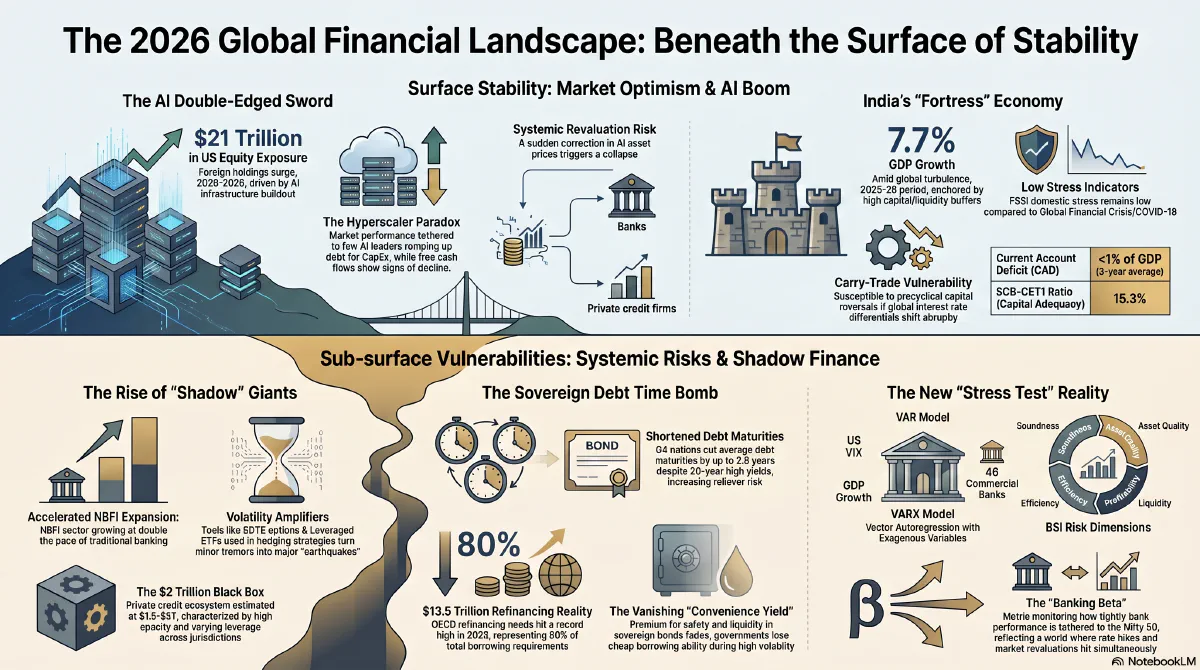
The “AI-driven boom” is the primary engine of current market performance, but it has created a historic level of concentration. Global market health is now precariously tethered to a handful of “hyperscalers” leading the AI infrastructure buildout.
The scale of this exposure is massive: by March 2026, foreign holdings of US equities reached a staggering $21 trillion, up from $7.5 trillion in 2020.
This capital isn’t just following growth; it is concentrating in a narrow corridor of firms. A paradox has emerged: while these hyperscalers are stock market darlings, they are simultaneously ramping up debt issuances to fund enormous capital expenditures, even as their free cash flows show signs of decline. The FSR warns that a sudden revaluation could trigger a systemic collapse:
“An AI-driven asset price correction could pose systemic risks through this channel, as banks may be indirectly exposed through their exposure to private credit firms and other key financing intermediaries funding the AI boom.”
2. The Rise of the “Shadow” Giants: Risk Migrates to the Back Alley
There has been a fundamental shift in the geography of financial risk. While regulators were busy fortifying the “front door” of the banking system, risk simply moved to the back alley of Non-Bank Financial Intermediaries (NBFIs). This sector is now growing at double the pace of the banking sector.
Operating in an opaque, lightly regulated environment without direct access to central bank liquidity, these “shadow” giants use instruments that can turn a tremor into an earthquake:
- 0 DTE Options: High volumes of zero-day-to-expiry options are being used in dynamic hedging strategies that can amplify market moves during stress.
- Leveraged ETFs: Mechanical rebalancing in these funds is increasingly driving outsized price swings.
- Private Credit: Now estimated at $1.5 to $2 trillion, this ecosystem is notoriously difficult to map. The report highlights that its “opacity and varying levels of leverage” across jurisdictions make it a black box of interconnectedness.
3. The Sovereign Debt Time Bomb: Shortening Maturities
In a counter-intuitive move, as yields hit 20-year highs, G4 nations (US, Germany, Japan, and the UK) have made their debt portfolios riskier by shortening issuance maturities. Over the last three years, the average maturity has been cut by 0.1 to 2.6 years.
This has set the stage for an unprecedented rollover risk.
In 2025 alone, the refinancing needs of OECD countries hit a record $13.5 trillion, representing 80% of total borrowing. Simultaneously, the “convenience yield”—the premium investors pay for the liquidity and safety of sovereign bonds—is declining. When this safety premium fades, governments lose their ability to borrow at cheaper rates just as volatility rises.
The danger is amplified by price-sensitive hedge funds. These players are heavily involved in “sovereign bond arbitrage trades,” using high leverage to exploit the cash-futures basis. In a stressed market, these funds could be forced into “fire sales,” triggering a rapid unwinding that spills over into the broader global economy.
4. India’s “Fortress” Economy: Resilience Amid Carry-Trade Reversals
Amid global turbulence, India has emerged as a “fortress” economy, maintaining a 7.7% GDP growth rate for 2025-26. This resilience is anchored by high capital and liquidity buffers that insulate the domestic system from external shocks.
The Financial System Stress Indicator (FSSI) confirms this strength; despite an uptick caused by the West Asia conflict, stress levels remain relatively low compared to previous episodes like the Global Financial Crisis or COVID-19. However, the report adds a note of caution regarding capital flows. Much of the recent inflow to Emerging Market Economies (EMEs) is “carry-trade-driven,” seeking to exploit interest rate differentials. Because these flows are procyclical, even a “fortress” like India remains vulnerable to abrupt reversals if global risk appetite shifts.
India’s Macro-Stability Ratios
| Indicator | Value / Average |
|---|---|
| Current Account Deficit (CAD) | <1% of GDP (3-year average) |
| SCB-CET1 Ratio | 15.3% |
5. The New “Stress Test” Reality: The VARX Model and “Banking Beta”
The 2026 report pulls back the curtain on the technical rigor now required to measure stability. The Banking Stability Indicator (BSI) now aggregates risk across six dimensions: soundness, asset quality, profitability, liquidity, efficiency, and sensitivity to market risk.
To account for the current “polycrisis,” regulators have moved beyond simple projections to a sophisticated VARX model (Vector Autoregression with Exogenous Variables). This model tests 46 scheduled commercial banks over a two-year horizon, using exogenous variables like the US VIX and US GDP growth, alongside endogenous factors like CPI inflation.
The tests project GNPA and slippage ratios under three distinct scenarios: a baseline and two hypothetical adverse scenarios. A key “insider” metric now being monitored is the “Banking Beta”—a measure of how tightly bank performance is tethered to the Nifty 50. This technical depth shows that regulators are no longer just looking at bank balance sheets in isolation; they are modeling a world where interest rate hikes and market revaluations hit simultaneously.
How India defending Rupees
Conclusion: The Precarious Path Ahead
The 2026 FSR captures a profound tension between immediate resilience and systemic fragility. While India’s macro-stability remains a global outlier, the broader “pivot” from rate-cut expectations to “extended pauses or hikes” suggests that financial conditions will remain tight for longer.
The ultimate question for the tech-savvy investor remains: Is the current AI-driven optimism a fundamental shift in economic productivity, or is it a high-leverage mask for growing fragilities in the bond and shadow banking sectors? The fortress stands for now, but the walls are being tested by a $13.5 trillion refinancing reality.